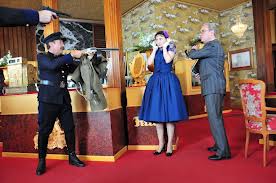
Friday, 22 March 2013
¡Viva! 2013: La chispa de la via Review
Álex de la Iglesia’s La Chispa de la via (As Luck would have It) is an abomination that gets progressively worse until it becomes unbearable. For a start, it’s a ‘black comedy’ which is always a tricky genre to get right. I can’t think of any great black comedies off the top of my head. Of course they exist, but they usually miss the mark a little. (Ah, In Bruges that was one, and that was well done. Oh, and Fargo.) This one, starring José Motael as Roberto and Selma Hayek as his wife Luisa, misses the mark entirely. Its intent is to be a satire on the relentlessness and immoral core of the media, or something along those lines, but it is nowhere near intelligent or insightful enough (Harold and Maud is another by the way).
Roberto is an unemployed advertising executive who once showed talent, he came up with the slogun ‘Life’s little spark’ for a Coca Cola campaign, but for the past two years has struggled to find work. He leaves home one morning for an interview he doesn’t get, is ignored by his old acquaintances and has a mildly funny interlude involving a sprinkler, a coffee machine and a soaked suit. On a quest to find a hotel he once stayed in with his wife, he somehow ends up hovering above a half renovated museum floor hanging on to a statue held by a crane. He awkwardly lands with an iron rod stuck in his head and is left immobilized.
Meanwhile, the museum director is giving a grand opening tour of the place and her and her colleague are displeased by the situation, thinking it will ruin their reputation and the precious artifacts of the museum. Soon enough, masses of people are crowding around Roberto to see what the fuss is about. Journalists and photographers arrive in abundance and he is on every TV channel. He is still conscious and immediately sees the potential profit in his situation, ringing around his marketing contacts to arrange exclusive interviews. Product placement is one source of the ‘humour’, as his agent perches by his paralyzed body holding up bottles of a mojito drink and grinning.
When his wife arrives, she instantly goes in to hug him, putting on too much pressure and he cries out in pain. It’s supposed to be funny, but this happens repeatedly. His wife later stamps her feet in annoyance, near his head. When his goth son arrives wearing large black boots, he does the same and Roberto yelps in the same way. Crowds are chaotically always buzzing around him, making the ground wobble profusely and no one stops it. This was really grating, as the doctor says only once that is the rod moves even slightly and touches another part of his brain he could die instantly. It just wouldn’t happen. True, that’s probably part of the joke, but I wasn’t in on it.
Roberto is irritatingly obsessed with money. He may be dying but all he can talk about is how much is being offered, and how he’s a celebrity now. This is obviously the point, and it’s a lecture in how money and fame can’t bring happiness. Family is what is important, as his wife and kids keep telling him. Isn’t this an obvious point to begin with? Roberto is just a broken record, as is much of the film itself. Dialogue, jokes, the statement it’s trying to make, are all hammered to death, hence why it’s hard to care about him or any of the other characters. Near the end of the film there is a rush of sentimentality, but it’s too generic and clichéd to be moving. Roberto’s kind words about how much he loves his family are also unconvincing as he has uttered so few words about them, except about how he can now pay their tuition fees. As Luck would have It is an all too obvious attempt at critiquing tabloid and television culture, but it can’t decide quite where it wants to be, and ends up in a very compromising position with no spark in sight.
1/5
This review was written for Front Row Reviews in connection with the Cornerhouse. The original review can be found here
¡Viva! 2013: La voz dormida Review
Benito Zambrano’s feature is a powerful and engrossing drama based on the award winning novel by the late Dulce Chacón, which was based on real-life testimonies and set in the aftermath of the Spanish Civil War. La Voz Dormida (The Sleeping Voice) tells the tales of women tormented by the war in an enlightening way, displaying scenes of cruelty and oppression that manage to never sink into melodrama. A film of such charged emotional intensity, with a romantic backdrop, could easily have evoked elements of clichéd sentimentality. Thankfully this is avoided as the lead performances are weighty and moving, and the film captures with empathy and unflinching honesty a vile epoch in Spain’s political history.
The focus in on the fate of two sisters during the frightening period of Franco’s dictatorship when those opposed to the regime or connected to them are imprisoned or executed. Proud and spirited Hortensia (Inma Cuesta), a politically active Repulican, is seven months pregnant and experiencing barbarous conditions in a Ventas prison where she awaits the death penalty. Her dissenter husband, Felipe, is hiding in the mountains and her innocent and apolitical sister Pipita (Maria Leon, who won Best Actress kudos at the San Sebastian festival) has moved from Cordova to Madrid in a naive attempt to help her sister’s impossible situation.
Barely literate, Pipita manages to hold down a job in an affluent household as a maid, working for a cold mistress who is introduced painting images of boys in their uniform giving the fascist salute. One one occasion Pipita desperately and brazenly pleads with a merciless general, the grandfather of the home, to help her sister. He later spits at her “only God and Franco can help her now”.
Amongst the suffering, Pipita meets and falls for charming fighter Paulino “Black Jacket” (Marc Clotet) when she reluctantly agrees to deliver some forged identity documents to her brother in law. The scenes between them are touching and with a dose of humour as Pipita’s charisma and wit shines through. (Another, unexpected comical touch is the doctor leading the birth of Hortensia’s baby with a cigarette casually hanging out of his mouth). The difficult circumstances that their love withstands is actually a true story.
The style is understated and the cinematography is without any particularly original features, yet this is irrelevant when there is so much here to hold attention. The opening scene for example goes straight for the jugular when a terrified woman has been called forward by the callous wardens and nuns to be killed by firing squad, between her sobs, she says “I can’t move, I’ve wet myself”. Equally harrowing is the way religion and the state blur as one, militant atheists in the prison are badly beaten when they refuse to kiss the foot of a Jesus doll and Hortensia is subject to much abuse when she refuses to have her child baptized. The Sleeping Voice has much to be admired, Zambrano has created an engaging exposé of experiences that were forced to keep quiet for many years.
4/5
This review was written for Front Row Reviews in connection with the Cornerhouse. The original review can be found here
¡Viva! 2013: 30 años de oscuridad Review
This intriguing documentary from Manuel.H.Martin is engaging from start to finish. Nominated for the Best Documentary Award at the 2012 Goyas, 30 Years of Darkness uses pleasing animation to illustrate the stories of 'moles' that were forced to hide away due to the Franco regime after the Spanish Civil War.
The focus is on the astonishing life of Manuel Cortes, a socialist former barber turned Mayor of Mijas, and the remarkable ordeal he underwent during thirty years in confinement. With the help of his wife Juliana, he hid in the walls of their Spanish home, always with the possibility of being discovered.
Only she and his father knew of his whereabouts, his presence was even kept secret from his young daughter for several years. He had to peer at her through a small hole, unable to embrace or play with her. Jesus Torbado co-wrote the book that tells Cortes’ story, and along with different historians enlightens the viewer on the historical background (essential information ashamedly, in my case) in an accessible fashion.
Cortes’ experience is an inspiring statement of how far a man would go to escape death, yet it also pose the question; is a life lived in such a way worth living? Sadly but unsurprisingly, other ‘moles’ mentioned had fought with madness and taken their own lives. Each man had his own methods of making life bearable. One man, hidden in an attic for decades, enforced upon himself a strict regime of reading and learning.
Cortes, much to his wifes dismay, coped by simply peering out of the window at life passing by in the street below. Obviously, this was a huge risk. He would also listen to the radio religiously, using it to speculate about the fate of the world around him, and listen out for any indication of a changed situation in Spain when he would be a free man.
Distress and fear was not restricted to the men themselves. Their wives and children underwent serious psychological stress and pressure in an attempt to keep such an important secret. Villages were divided as trust dissipated. Cortes’ wife burned all photographs of her husband, only for one of her neighbours to hand one in to the authorities in an attempt to appear on the side of the Franco regime. If a woman became pregnant, she had to fabricate numerous lies to fight off raised suspicion.
30 Years of Darkness will certainly give your daily woes some perspective. These are tales of loss, humanity and the repercussions of war and dictatorship. It is recommended as an intimate insight into extraordinary lives and as a means to learn about crucial aspects of Spain’s tortured past.
4/5
This review was written for Front Row Reviews in connection with the Cornerhouse. The original review can be found here
The focus is on the astonishing life of Manuel Cortes, a socialist former barber turned Mayor of Mijas, and the remarkable ordeal he underwent during thirty years in confinement. With the help of his wife Juliana, he hid in the walls of their Spanish home, always with the possibility of being discovered.
Only she and his father knew of his whereabouts, his presence was even kept secret from his young daughter for several years. He had to peer at her through a small hole, unable to embrace or play with her. Jesus Torbado co-wrote the book that tells Cortes’ story, and along with different historians enlightens the viewer on the historical background (essential information ashamedly, in my case) in an accessible fashion.
Cortes’ experience is an inspiring statement of how far a man would go to escape death, yet it also pose the question; is a life lived in such a way worth living? Sadly but unsurprisingly, other ‘moles’ mentioned had fought with madness and taken their own lives. Each man had his own methods of making life bearable. One man, hidden in an attic for decades, enforced upon himself a strict regime of reading and learning.
Cortes, much to his wifes dismay, coped by simply peering out of the window at life passing by in the street below. Obviously, this was a huge risk. He would also listen to the radio religiously, using it to speculate about the fate of the world around him, and listen out for any indication of a changed situation in Spain when he would be a free man.
Distress and fear was not restricted to the men themselves. Their wives and children underwent serious psychological stress and pressure in an attempt to keep such an important secret. Villages were divided as trust dissipated. Cortes’ wife burned all photographs of her husband, only for one of her neighbours to hand one in to the authorities in an attempt to appear on the side of the Franco regime. If a woman became pregnant, she had to fabricate numerous lies to fight off raised suspicion.
30 Years of Darkness will certainly give your daily woes some perspective. These are tales of loss, humanity and the repercussions of war and dictatorship. It is recommended as an intimate insight into extraordinary lives and as a means to learn about crucial aspects of Spain’s tortured past.
4/5
This review was written for Front Row Reviews in connection with the Cornerhouse. The original review can be found here
Wednesday, 13 March 2013
¡Viva! 2013 - ¡Atraco! Review
This week I'm covering the 19th edition of the Spanish and Latin American festival ¡Viva! at the Cornerhouse Cinema in Manchester. Documentaries, dramas and comedies are being screened until 24th March. It's a good opportunity to access films that I wouldn't see otherwise and to see films that are just a bit different, from the perspective of other cultures. I'm enjoying my local cinema being a second home for the moment.
My outline of the festival on Front Row Reviews can be read here
Friday 8th March was the ¡Viva! 2013 festival’s opening gala at the Cornerhouse in Manchester. lt began with the UK premiere of ¡Atraco! (Hold Up!), a tragi-comic heist caper set in 1950′s Madrid that nods to classical Hollywood cinema. Inspired by real events, this Spanish/Argentinian co-production revolves around a complex feigned robbery of a jewellery shop.
The mission is oraganised to prevent the wife of Spain’s dictator General Franco from obtaining jewels once owned by Argentinia’s first lady Eva Perón (Evie). Guillermo Francella, (Argentina’s Oscar-winner The Secret in Their Eyes) plays passionate Perón loyalist Merello designated as the man for the job. Nicolás Cabré plays his incompetant younger colleague Miguel, a sweet Charlie Chaplin imitator who can’t stand violence. Amaia Salamanca plays the beautiful, wide eyed nurse who Miguel falls in love with. Óscar Jaenada and Jordi Martínezplay the policemen hunting them down.
The film is a blend of crime, comedy, romance and drama. Its intention is to appear as if from another era, and in this sense it well crafted. The big-band score from the Budapest Jazz Orchestra accompanies the 1950s costuming and slapstick humour. There were regular laughs from around half of the audience, and after the credits rolled there was a steady applause, yet I’m afraid I didn’t feel it. The comedy was tame and familiar. I cannot praise the film wholeheartedly when I didn’t laugh once, as that is the purpose of comedy after all.
True, the film would appeal more to family audiences. There is a serious undertone, and bursts of solemnity, but the break away from comedy feels jarring and tiresome. ¡Atraco! is well meaning enough, it stylistically achieves the result it intended, and has a warm hearted core. Still, ¡Viva! festival will assuredly have stronger works to display during the upcoming fortnight.
2/5
This review was written for Front Row Reviews in connection with the Cornerhouse. The original review can be found here
Friday 8th March was the ¡Viva! 2013 festival’s opening gala at the Cornerhouse in Manchester. lt began with the UK premiere of ¡Atraco! (Hold Up!), a tragi-comic heist caper set in 1950′s Madrid that nods to classical Hollywood cinema. Inspired by real events, this Spanish/Argentinian co-production revolves around a complex feigned robbery of a jewellery shop.
The mission is oraganised to prevent the wife of Spain’s dictator General Franco from obtaining jewels once owned by Argentinia’s first lady Eva Perón (Evie). Guillermo Francella, (Argentina’s Oscar-winner The Secret in Their Eyes) plays passionate Perón loyalist Merello designated as the man for the job. Nicolás Cabré plays his incompetant younger colleague Miguel, a sweet Charlie Chaplin imitator who can’t stand violence. Amaia Salamanca plays the beautiful, wide eyed nurse who Miguel falls in love with. Óscar Jaenada and Jordi Martínezplay the policemen hunting them down.
The film is a blend of crime, comedy, romance and drama. Its intention is to appear as if from another era, and in this sense it well crafted. The big-band score from the Budapest Jazz Orchestra accompanies the 1950s costuming and slapstick humour. There were regular laughs from around half of the audience, and after the credits rolled there was a steady applause, yet I’m afraid I didn’t feel it. The comedy was tame and familiar. I cannot praise the film wholeheartedly when I didn’t laugh once, as that is the purpose of comedy after all.
True, the film would appeal more to family audiences. There is a serious undertone, and bursts of solemnity, but the break away from comedy feels jarring and tiresome. ¡Atraco! is well meaning enough, it stylistically achieves the result it intended, and has a warm hearted core. Still, ¡Viva! festival will assuredly have stronger works to display during the upcoming fortnight.
2/5
This review was written for Front Row Reviews in connection with the Cornerhouse. The original review can be found here
Sunday, 10 March 2013
Lore - Review
The setting is Germany, 1945. Lore (Saskia Rosendahl is her debut role) is a 14 year old girl who has been raised as an anti-Semite. Her Nazi parents are being hunted by the Allied forces. Her father, a high-ranking SS officer, shoots the family dog and burns all incriminating documents before fleeing. Her mother, seemingly repressing even a flicker of maternal devotion, gives Lore jewellery to sell for food and leaves her in charge as she leaves for an internment camp.
The five siblings – one still a baby – must travel to their grandmother’s house in the north. It becomes a battle of starvation and an eye opening journey through the wilderness, as the young are exposed to images of concentration camps and gradually realise that the situation were never as it appeared to be. Lore experiences a sexual awakening when she meets a young refugee named Thomas (Kay Peter Malina), a Jew. She is as attracted to him as she is repulsed. There is little dialogue between the two, just immense tension and stares of rich intensity and curiosity.
Cate Shorland's Lore adopts an interesting, alternate perspective of post war Germany. It poses the questions; Are the Nazi offspring victims of racism despite holding the same ideology? Are such core nurtured and hostile prejudices against others capable of changing? There are symbolic parallels in tandem here. The Fuhürer is dead, and a fragmented Germany is left to pick up the pieces. The children are in a sense, an embodiment of the country itself, abandoned by their parents and having to fend for themselves. Adam Arkapaw's rich and beautiful cinematography has contributed largely to the film's wide critical acclaim. The general consensus seems to be that Lore is outstanding. It certainly is a bold and provocative piece of work, with impressive elements. However, I felt obliged to adore it rather than actually doing so. Admittedly many films are not designed to be 'likeable' but regardless, they can be greatly admired. This wasn't the case personally, and I feel almost blasphemous for writing this, the film felt a little forced at times.
The camera remains in intimate proximity to the natural setting, abruptly changing from a close up of a dandelion to a flock of birds flying over boughs of a tree. When the children come across a corpse covered in blood, the camera zooms in on ants marching over the stained red skin. Saskia Rosendahl gives a strong debut performance as Lore, but there is more emphasis on her beauty and desirability than her character and her moral dilemmas. This is cinema relishing in it's role as an art form in a self conscious fashion.
3/5
Wednesday, 6 March 2013
Shame and Martha Macy May Marlene - Gems of 2012
I wrote the following article for the digital magazine Chameleon, which is available on Amazon to download
here It's rather long, too long, and for that I do apologise.
The past couple of years - particularly for British cinema, which has arguably been going through a renaissance - has produced some seriously substantial film making from established and debut auteurs alike. Personal highlights of recent times have been Richard Ayodade's quirky, beautifully photographed and irresistibly likable debut film 'Submarine' in 2011. Lynne Ramsay's 'We Need To Talk about Kevin' was another. The Scottish director deservedly returned to the spotlight after eight years, with her exceptionally dark adaptation of Lionel Shilvers novel. As with her previous works, 2002's Morvern Callar and her debut 1999's 'Ratcatcher', 'We need to Talk about Kevin was an eerily disturbing and beautifully formed triumph.' What a travesty for the cinema world it was when Ramsays role in adapting Alice Sebold's novel 'The Lovely Bones' was dropped by Film4 in favour of Hollywood director Peter Jackson in 2009. The result was frankly embarrassing; a saccharine and sentimental atrocity.
It could be said that the most striking of contemporary British film talent has been Turner Prize winning artist Steve McQueen. His directional debut Hunger was an explicit and brutal account of the hunger strikes in Ulster's Maze prison that ended in the death of Bobby Sands, played by Michael Fassbender. The two were reunited in 'Shame.' With the beautiful photography of Sean Bobbitt, Abi Morgan as co-writer ('The Iron Lady', 'The Hour') and a sleek soundtrack by Harry Escott, Shame is a sublime work of art and my highlight of 2012. McQueens artistic background is evident in his eye for composition and fierce visual images. Another memorable feature film was Sean Durkin's impressive debut 'Martha Macy May Marlene' ,an unsettling American psychological drama released in the same year.
My itching curiosity to see Shame led me onto a train from Manchester to Leeds after work in November 2011. I was intrigued as to how a film would depict something as controversial as sex addiction I had a pass for the International film festival, it was a Friday night and Shame was the closing gala screening, prior to UK release. The coffee shops had shut, but I was early for the screening and had to spend an awkward hour sat in the Slug and Lettuce in a corner with my novel, surrounded by rowdy drinkers and eagerly awaiting 8pm when the film would begin. The train home was delayed and covered in the vomit and drool of a very drunk man. I arrived home at 1am.
It was all worth it. I dawdled out of the screening in a daze, with intense admiration for everyone involved in the film and everything about it. One year on from its release, the suburb fierce performances have remained under my skin. It has even rivaled Withnail and I as a contender for my favourite film of all time, a significant moment, (still undecided on this one.Those unemployed, quotable heroes have a place in my heart forever).
Shame focuses on Brandon, a handsome and affluent executive living in New York. His particular field is never specified, and is irrelevant. What is important is the fact his office is shiny and immaculate, complete with city views. It is much like his expensive, minimalist apartment, to complete the image of ultimate success. It is just an image, though. The reality is a melancholic, isolated existence driven by his relentless sex drive. He masturbates in toilet cubicles at work several times a day, watches porn whilst causally eating noodles at dinner, and has regular encounters with prostitutes. When Brandon's younger sister Sissy arrives unwanted, out of the blue, her presence threatens to destroy his private space and expose his addiction. Despite her efforts to connect with him, he remains cold and guarded.
Martha Macy May Marlene is a disquieting indie film about a young woman named Martha, and her experiences in a commune she has fled from. The film opens with her running through a forest and hiding behind some growth whilst figures walk past, hunting for her. Shortly after this she is on a payphone, hysterical and only with a vague idea of her whereabouts. Her older sister (Sarah Paulson) comes to collect her, and brings her back to the luxury lake house she shares with her wealthy British husband (Hugh Dancy).
As Martha takes refuge, she suffers from paranoia and disturbing flashbacks of what we later discover has been a two year stay at the farm. She is haunted by her memories, and struggles to distinguish between what is dream and what is reality. The sinister tone builds gradually. Early flashbacks show a smiling and content Martha, arriving at what ostensibly is a friendly, bohemian commune. As the flashbacks continue, it becomes clear there is something not right. This is a cult run by a creepy man named Patrick (John Hawkes), who renames his followers himself - Martha becomes 'Marcy May'- and dominates them completely. One eery scene shows him perched on a step, simply over looking group sex between his devotees, distanced yet revelling in his power.
Shame and Martha Macy May Marlene have a great deal in common. They are both rich with ambiguity, feature damaged sibling relationships, and characters with dysfunctional approaches to sexuality. In both films, details of the characters' past is hinted at but never explained. In Shame, Sissy tells Brandon over voice mail "we are not bad people, we just come from a bad place". We never find out more, other than the "place" is Ireland. In the latter film, Lucy apologies to Martha for not "being there" enough when growing up, as it becomes apparent their parents were dead or absent. Martha refuses to converse. This means neither film is reduced to melodrama or sentimentality. Both films use dialogue sparingly but what is said is cleverly revealing. Camera shots can reveal just as much. Close up shots of Sissy and Brandon as she sings her slow rendition of New York, New York in a high class piano bar reveals the sadness behind her bouncy exterior, and the emotion behind Brandon's icy demeanor. As the camera lingers on him, he is clearly moved by her talent as an aspiring singer, and a tear falls down his cheek.
The audience is somewhat distanced during both films. In Shame, many scenes feel utterly voyeuristic. Brandon shares an passionate encounter with his Marianne (Nicole Beharie) , a co worker he has enjoyed a date with and the only character he shares any connection with.The acting is so convincing it feels almost wrong to bear witness to it, but the clear emotion they share is moving.The scene becomes a sad insight into the contrast between sex to fulfill an addiction and sex with real feeling. One explicit group sex encounter he has is deliberately just that bit too long, and it is a relief when we are set free of his expression of emotional pain rather than physical pleasure, and onto the next location. The scenes are relentlessly honest and completely unforgiving. It is a refreshing representation of sex in film.
Martha Macy May Marlene also conceals as much as it reveals. As it juxtaposes time and space, the present in a spacious lake house in Connecticut, and the past in a cramped farmhouse, We never stay too long in either. We hear and see just enough to understand the brutality of the cult and the severe effect it has on Martha's mind. The most startling and disclosing scene is when Martha, unable to sleep one night, wanders into Lucy and Ted's bedroom when they are making love, and curls up on the corner of the bed. Lucy has to tell her that 'it's private!' as she is worryingly unaware what the issue is. The film is also equally mysterious. Drama blends with thriller when Martha calls the farmhouse, before hanging up. The phone rings back. Martha experiences paranoid delusions, but does she have a reason to? Are her 'family' able to track her down? The ambiguous ending only continues the mystery.
The relationships between the siblings in both films are complex and equally ambiguous. Martha has disappeared for two years, and intentionally becomes impossible to contact. She simply tells Lucy that she had a 'boyfriend' who she had split from. They are awkward in each others company. Upon hearing that Ted and Lucy are trying for a baby, Martha erupts into hysterical laughter. Later, during an argument Martha tells Lucy that she going to be a 'terrible mother', a comment we can only guess at the reason for. The relationship between Sissy and Brandon remains intriguing. There are incestuous undertones that only remain a whisper of a possibility, that as a viewer it is impossible to determine.
There are frequent moments when the space they share becomes too close for comfort. When Sissy arrives unwarranted, Brandon barges in on her in the shower with a baseball bat, mistaking her for a burglar. Sissy stands naked, giggling at the situation comfortably, whilst Brandon remains cold. Similarly, later in the film Sissy walks in on Brandon masturbating. Her reaction is to shut the door and laugh, whilst Brandon is simply furious. Sissy yearns for hugs that Brandon will not yield too. In one scene she climbs into his bed and says 'it's cold'. Infuriated, he swears at her to get out. Sissy speaks for the audience when she later says: "I make you angry all the time, and I don't know why".
Sissy and Martha are disconnected outsiders that show their skepticism of the lifestyles that they disturb. Ted and Lucy are proud of their accomplished happiness and wealth. Martha's questions bursts their bubble. 'Why is the place so big?', she asks. Another time she bluntly demands: "Is it true that married people don't fuck?". Likewise, an argument between Sissy and Brandon has him defending himself with the fact he has his own apartment. Sissy's sarcastic response: "You have your own apartment, whoopie fucking shit. And a job, that's amazing, I'm in awe of you" is similar to Martha telling priggish Ted that there are "other ways" to live than to have a career and take pride in possessions.
Neither film resorts to the most obvious turn of events. Brandon's connection with Marianne does not miraculously change him and solve his issues. He may bin his porn stash after their date, but McQueen acknowledges the deep rooted psychological causes of addiction; it cannot be instantly fixed. Ted and Lucy are flawed characters rather than cut out ideals of a bourgeoisie couple. Martha's troubled mind only seems to worsen.
Durkin and McQueen leave the fates of their characters to be a wonder long after the credits have rolled.
Repulsion - Review
Repulsion is a disturbing exploration of one woman's isolation and descent into madness. Carol (Catherine Deneuve) works in a beauty parlour in London and lives in a rented flat with her sister Helen (Yvonne Furneaux). She appears disconnected from the world and is unable to respond to those who attempt communication, often drifting into a dream-like state where she simply stares ahead vacantly.
When Helen goes on holiday with her lover and she is left alone, Carol's time and space become distorted as she is haunted by her past and begins halluncinating. Polanski is well known for his fascination with the grotesque. In the confined claustrophobic space of the apartment where most of the film is set, Carol has removed a skinned rabbit from the fridge and left it on a table to rot and attract flies. Potatoes begin sprouting long, crooked shoots. The objects are unsettling, as much as the violence that occurs later in the film, as they reflect Carol's lack of awareness of her body and mind. She doesn't appear to eat for days.
The film brilliantly instils a sense of unease. Initially the style appears as pure realism, documenting days in the life of a disturbed young woman. The pace is slow, tension builds gradually and the camera never leaves her. The film then turns to the surreal and horrific as the walls expand and space becomes flexible and distorted. Giant cracks appear and groping hands burst out from the walls. Reality and her nightmare world infuse together in a disconcerting fashion.
The title refers to Carol's strong abhorrence of all men, due to implied sexual abuse from her father. Helen is having an affair with a married man, early in the film Carol cannot stand his toothbrush being in her glass, and she throws it in the bin. Her beauty is a danger to her, her space is consistently invaded by men, even as she walks down the street she is leered at lustfully. When she fails to react to a young man's relentless pursuit of her, 'forgetting' their dates and ignoring his phone calls, his obsession drives him to kick down her apartment door. When she fails to deliver the rent money to the landlord, he comes to claim it and soon becomes fascinated by her naked thighs in her nightdress.
Repulsion's incentive is to portray the ramifications of the destructive and intrusive male gaze, an undoubtedly daring approach for the 1960's. The most impressive aspect of Roman Polanski's Repulsion is how strikingly contemporary it seems, 47 years on from its release. Steve McQueen's Shame springs to mind as a comparison. Both films share a similar voyeuristic quality and detached protagonists stifled by loneliness. Shame focuses on Brandon pursuing his sex addiction and being increasingly disconnected from those around him; we watch him wandering around his apartment, masturbating in toilet cubicles, and sleeping with prostitutes. Yet despite his relentless pursuit of sex, he is also clearly repulsed by it. One woman repeatedly rings him and leaves flirtatious messages on his answering machine, similar to Carol’s ringing unanswered phone. Repulsion is a timeless psychological thriller that creepily captures the perspective of a deeply haunted mind.
4/5
Subscribe to:
Posts (Atom)
.jpg)